Field Notes — Manitoba
Happy Rock
Gladstone, Manitoba took its own name as a dare — glad means happy, a stone is a rock — and built the grinning 36-foot proof beside the Yellowhead Highway.
The Short Answer
Happy Rock is a grinning fibreglass statue about 36 feet (11 metres) tall beside Highway 16, the Yellowhead, in Gladstone, Manitoba. It was unveiled on July 1, 1993, and it doubles as the town's visitor information centre. Travellers stop for a photo, a picnic, and a stretch under Gladstone's wordplay made monumental.
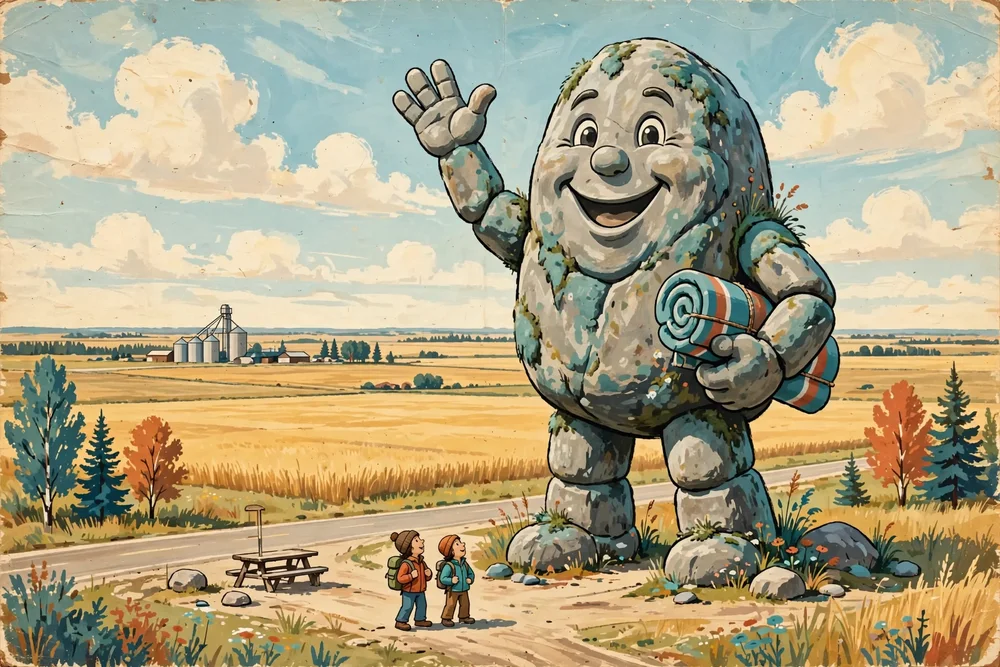
Some town names are just names. And then there’s Gladstone, Manitoba, which looked at its own name, did the wordplay out loud — glad means happy, a stone is a rock — and decided the joke deserved a monument.
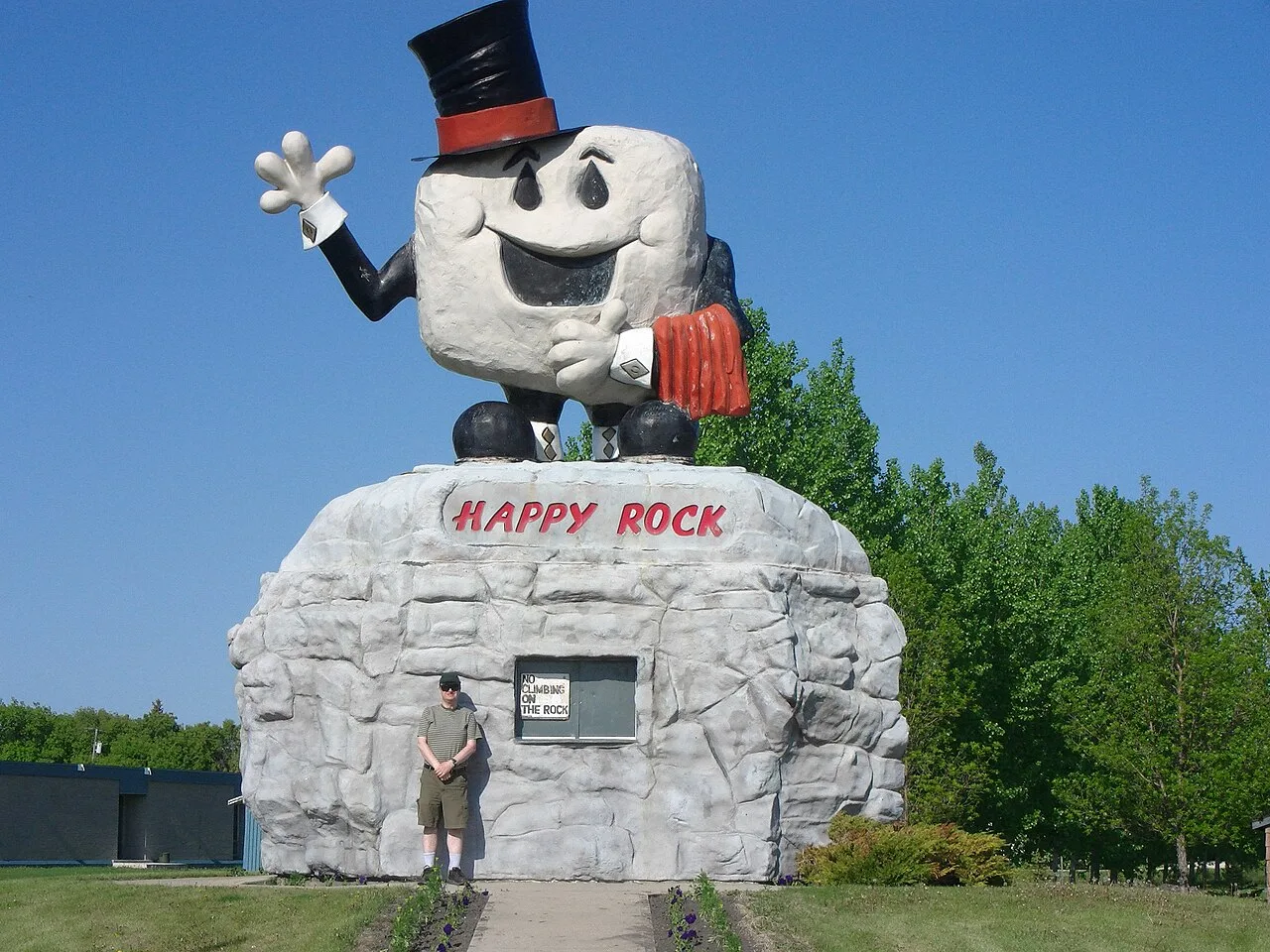
The monument is a rock. A giant, grinning, waving rock, standing about 36 feet (11 metres) tall beside the Yellowhead Highway, towel in hand like it’s permanently on its way to the beach. This is Happy Rock, and it might be the purest roadside statue in Canada: a pun, built at full scale, with feeling.
From a Logo Contest to a Landmark
The idea started with tourism. In the late 1970s, the province was encouraging small communities to find ways to draw travellers off the highway, and Gladstone — long nicknamed “Happy Rock” — had its symbol sitting right there in the name.
In 1984, the local Chamber of Commerce held a logo contest for a mascot. The winning entry, by Jerry Wickstead, was a cheerful black-and-white rock character: big smile, one hand waving, a towel over the other arm — a happy rock, ready for summer. A few years later the Chamber asked the obvious question: what if we built him?
The town fundraised the way small towns build everything — bingos, banquet dinners, prize draws, and a community grant — raising nearly $92,000. Winnipeg architects drew up the blueprints, and the F.A.S.T. Corporation of Sparta, Wisconsin, a specialist in giant fibreglass figures, built the rock in about four months. For all its bulk, the finished statue weighs only around 3,000 pounds — it’s a hollow fibreglass heavyweight, a heavyweight’s silhouette with a lightweight’s secret.
On July 1, 1993, Canada Day, Happy Rock was officially unveiled, doubling as the town’s visitor information centre. It has been waving at the highway ever since.
A Stamp of Approval
If you suspect Gladstone is in on its own joke, consider the evidence: in 2010, Canada Post issued a Happy Rock stamp as part of its Roadside Attractions series. The town’s smiling boulder carried the mail across the country — a fibreglass pun, elevated to federal recognition.
It’s sometimes billed as an “Ambassador of Smiles,” and honestly, the title fits the job description. Happy Rock doesn’t commemorate a battle, a founder, or a harvest record. It commemorates a mood. The town’s whole pitch to the passing world is contained in that wave: we’re glad you’re here. The name says so.
Other towns build statues to what they were. Gladstone built one to how it feels to arrive.
Worth the Drive
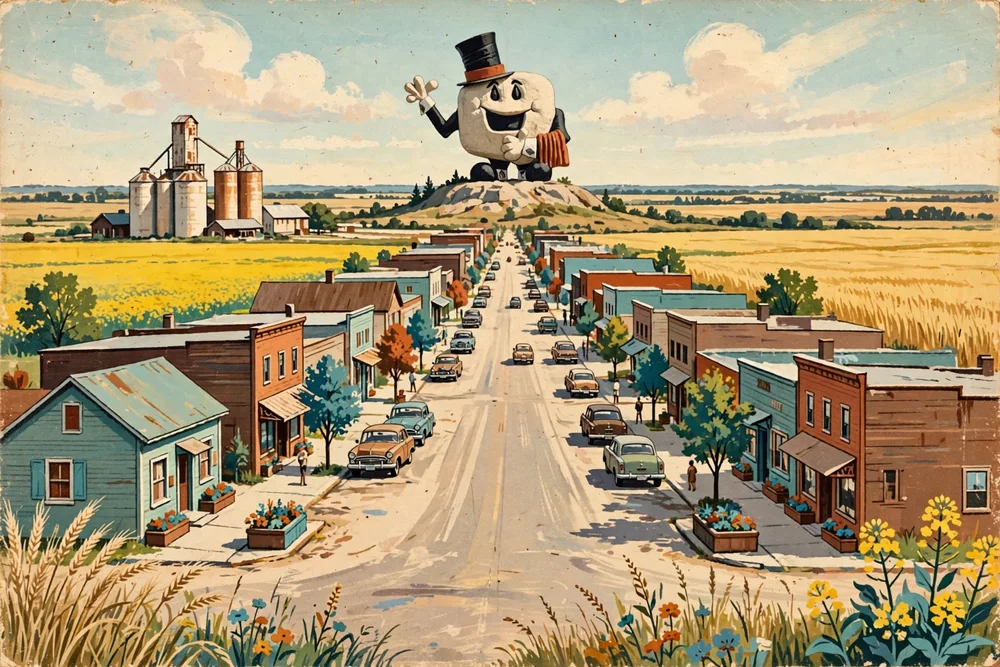
Happy Rock is not a long stop, and it doesn’t try to be. It’s a pull-off on Highway 16: stretch your legs, use the visitor centre, eat a sandwich in the shadow of a 36-foot smile, and take the photograph that explains Manitoba road trips better than any brochure — big sky, flat gold fields, and a town so pleased to see you that it built the feeling out of fibreglass.
And here’s the thing about Gladstone’s grin: it works. Drivers who had never planned to stop in Gladstone stop, because a waving rock is a hard invitation to turn down. Kids who will forget every museum on the trip remember the rock. The bingos and banquets of thirty years ago are still paying that off, one pulled-over car at a time — which is more than most tourism strategies twice the budget can say.
Wave back as you leave. Everybody does. That’s the whole point of him.
Common Questions
Where does Happy Rock stand?
Happy Rock stands on the northeast side of Highway 16, the Yellowhead, at Gladstone, Manitoba. It also serves as the town's visitor information centre.
How tall is Happy Rock, and when was it unveiled?
The statue is about 36 feet (11 metres) tall. It was officially unveiled on July 1, 1993, after the town raised nearly $92,000 for the project.
Why did Gladstone build a happy rock?
The statue grew out of Gladstone's nickname and the wordplay in its name: glad means happy, and a stone is a rock. Jerry Wickstead's cheerful rock won a 1984 logo contest, and the mascot was later built at full scale.
Can visitors climb on Happy Rock?
No. The article asks visitors to admire, photograph, and wave back, but not climb on the fibreglass statue. The grounds are set up as a picnic and stretch stop.
The Real Thing
More Strange Stops
Mac the Moose
Moose Jaw's Mac the Moose has watched the Trans-Canada Highway since 1984 — and when Norway built a taller moose, Saskatchewan answered with bigger antlers.

Falcon Lake: Canada's Strangest UFO Story
In 1967, a Winnipeg prospector walked out of the Whiteshell woods with grid-pattern burns and a story he never changed. You can still hike to the rock.